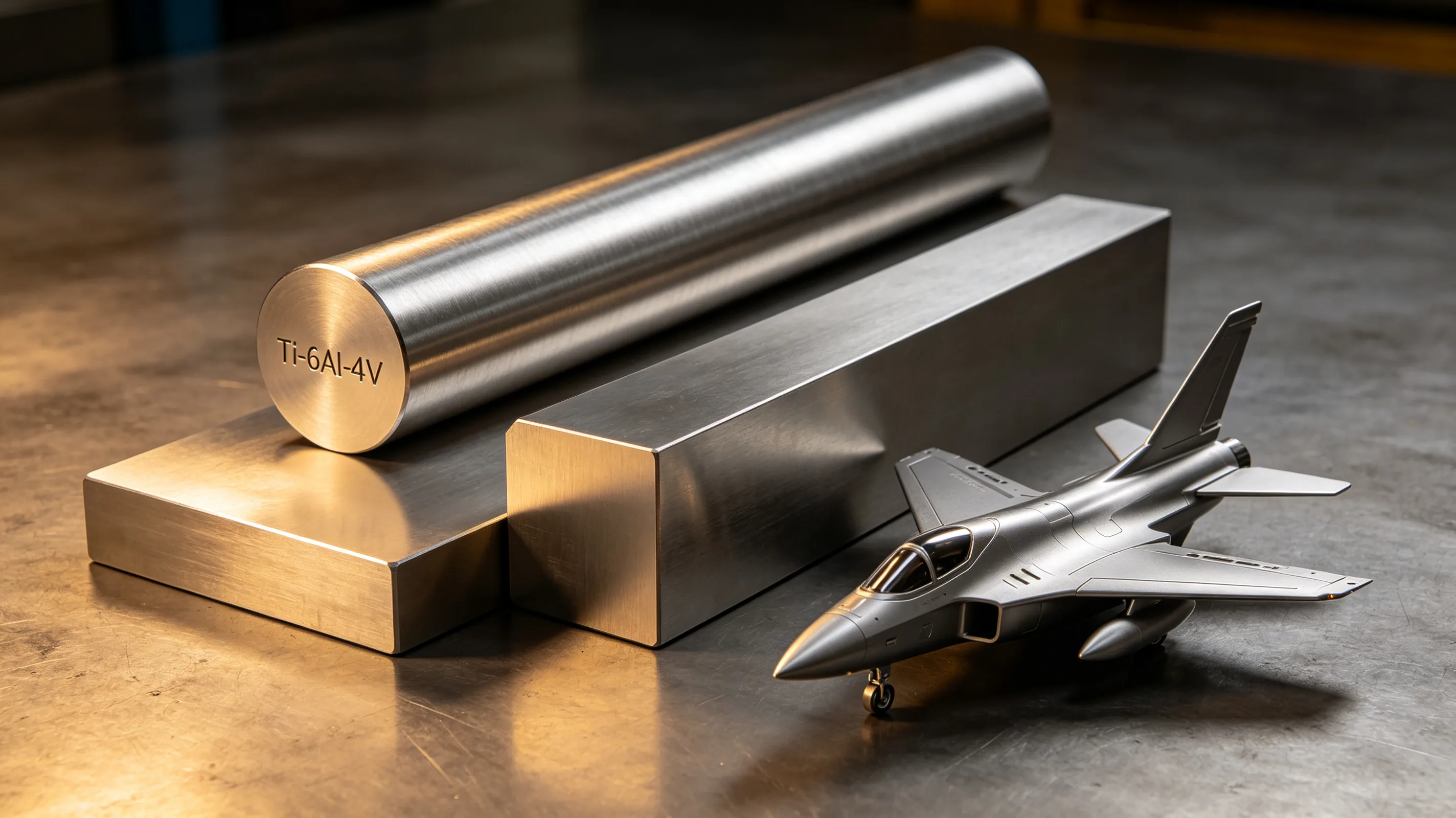
Boze Titanium Manufacturing Center has supplied precision Ti-6Al-4V components for aerospace, medical, marine, and industrial customers since 2008, and we routinely reference the standards behind every cert we issue. Our internal process capability database, cross-referenced against each customer’s first-article inspection report, is cited throughout this article according to ASTM, SAE, and MatWeb primary sources. If you are looking for titanium parts that must hold aerospace or medical tolerances, the engineering reference below gives you every property, standard, machining parameter, and procurement checkpoint you need to qualify Boze against your drawing. The article below is the engineering reference we hand to procurement teams who need to specify, buy, or audit Ti-6Al-4V (UNS R56400) — also known as Grade 5 in the ASTM system and as TA6V under the older French aerospace convention. For a broader walk-through of the entire titanium family, see the titanium grades complete guide.
“Ti-6Al-4V accounts for roughly fifty percent of all titanium alloy consumed globally — not because it wins any single property, but because it is the only alloy that delivers a balanced combination of strength, manufacturability, weldability, biocompatibility, and supply chain maturity at industrial scale.” Source: ASTM B348 introduction cited from the ASM Handbook Volume 2 reference at the close of this article.
1. What is Titanium 6Al-4V (Grade 5)?
Ti-6Al-4V is an alpha-beta titanium alloy in which the alpha phase is stabilised by 6 percent aluminium and the beta phase is stabilised by 4 percent vanadium. The nominal composition produces a two-phase microstructure in which the HCP alpha phase carries most of the strength at room temperature, while the BCC beta phase enables hot workability and heat-treat responsiveness. The unified numbering system designation is UNS R56400, the Werkstoff number is 3.7165 (DIN), and the Aerospace Material Specification variants are AMS 4911 (plate / sheet) and AMS 4928 (bar / billet / forging stock).
In the annealed condition (mill supply default, 700-790 °C hold followed by air cool), Ti-6Al-4V exhibits a tensile strength of 900-1000 MPa, yield strength of 830-950 MPa, and elongation of 10-18 percent. The microstructure consists of equiaxed primary alpha grains with intergranular beta — the workhorse condition for most structural aerospace and industrial applications.
In the solution-treated and aged (STA) condition, the alloy reaches 1100-1200 MPa tensile strength by transforming the beta into a fine dispersion of alpha platelets. The STA cycle is: heat to 940-975 °C, hold for 60-90 minutes, water quench to retain metastable beta, then age at 480-595 °C for 4-8 hours to precipitate fine alpha. For sections above approximately 25 mm, full through-hardening may not be achieved at the centre because the quench rate drops below the critical cooling rate, leaving centre-line properties closer to the annealed baseline.
2. Chemical Composition & Interstitial Element Limits
The composition limits below are taken from ASTM B348 Grade 5 and cross-checked against AMS 4928. The interstitial oxygen, nitrogen, carbon, and hydrogen ceilings are the single most important reason medical device engineers select the F136 / Grade 23 variant over standard Grade 5 for permanent implants.
| Element | ASTM B348 Grade 5 (wt %) | AMS 4928 (wt %) | ASTM F136 Grade 23 ELI (wt %) | Function |
|---|---|---|---|---|
| Aluminium (Al) | 5.5 – 6.75 | 5.5 – 6.75 | 5.5 – 6.50 | Alpha stabiliser; solid solution strengthener |
| Vanadium (V) | 3.5 – 4.5 | 3.5 – 4.5 | 3.5 – 4.5 | Beta stabiliser; improves hot workability |
| Iron (Fe) | 0.30 max | 0.30 max | 0.25 max | Beta stabiliser (residual); kept low for toughness |
| Oxygen (O) | 0.20 max | 0.20 max | 0.13 max | Interstitial strengthener; reduced in ELI for fracture toughness |
| Nitrogen (N) | 0.05 max | 0.05 max | 0.03 max | Interstitial; controlled to avoid embrittlement |
| Carbon (C) | 0.08 max | 0.08 max | 0.08 max | Interstitial; tied up as TiC to limit grain-boundary films |
| Hydrogen (H) | 0.015 max | 0.015 max | 0.012 max | Strictly controlled; hydrogen-induced cracking risk |
| Yttrium (Y) | 0.005 max | — | 0.005 max | Residual; tracked in aerospace melts |
| Titanium (Ti) | Balance | Balance | Balance | Matrix element |
“The F136 Grade 23 ELI ceiling of 0.13 percent oxygen — versus the 0.20 percent ceiling of standard Grade 5 — is the metallurgical boundary that separates structural aerospace use from permanent surgical implants. Lower interstitial oxygen directly raises fracture toughness and ductility, which is why F136 / Grade 23 is mandatory for spinal cages, hip stems, and load-bearing bone plates under ASTM F04 committee rules.”
3. Mechanical & Physical Properties
3.1 Mechanical Properties by Heat-Treatment Condition
| Property | Annealed (mill) | STA | Beta-Annealed | ELI (Grade 23) Annealed | Test Standard |
|---|---|---|---|---|---|
| Tensile strength (MPa) | 900 – 1000 | 1100 – 1200 | 900 – 1000 | 860 – 960 | ASTM E8 / E8M |
| Yield strength, 0.2 % offset (MPa) | 830 – 950 | 1000 – 1100 | 800 – 900 | 790 – 875 | ASTM E8 / E8M |
| Elongation (%) | 10 – 18 | 6 – 10 | 8 – 12 | 12 – 18 | ASTM E8 / E8M |
| Reduction of area (%) | 25 – 40 | 15 – 25 | 20 – 30 | 30 – 45 | ASTM E8 / E8M |
| Hardness, Rockwell C | 30 – 36 | 36 – 42 | 30 – 35 | 28 – 34 | ASTM E18 |
| Charpy impact, V-notch (J) | 18 – 30 | 10 – 18 | 20 – 35 | 30 – 45 | ASTM E23 |
| Fatigue endurance limit, 10⁷ cycles (MPa) | 500 – 600 | 600 – 700 | 480 – 580 | 500 – 600 | ASTM E466 |
3.2 Physical Constants
| Property | Value | Notes |
|---|---|---|
| Density | 4.43 g/cm³ | Specific strength roughly 1.7× aluminium, 0.6× steel |
| Melting range | 1604 – 1660 °C | Solidus to liquidus; beta-transus at ~995 °C |
| Beta-transus temperature | 995 ± 15 °C | Critical for heat-treatment process windows |
| Thermal conductivity | 6.7 W/m·K at 20 °C | Roughly 1/30 of carbon steel; drives heat accumulation in machining |
| Specific heat capacity | 0.526 J/g·K at 20 °C | Low; contributes to localised thermal gradients |
| Coefficient of thermal expansion | 8.6 × 10⁻⁶ /°C (20-100 °C) | Compatible with carbon and austenitic stainless steels |
| Elastic modulus (tension) | 113.8 GPa | About half of steel; drives springback and chatter risk |
| Shear modulus | 44 GPa | Relevant for fastener and torsion-locked joint design |
| Poisson's ratio | 0.342 | — |
| Electrical resistivity | 1.7 µΩ·m at 20 °C | Higher than CP titanium; relevant for EDM electrode design |
| Magnetic permeability | 1.00005 (paramagnetic) | Essentially non-magnetic; MRI and naval mine-safe |
“At 6.7 W/m·K the alloy concentrates cutting heat into the tool tip rather than conducting it into the chip — this is why Ti-6Al-4V tooling fails faster than it would on steel under otherwise identical parameters. Our shop floor standard is to derate cutting speed to 35-55 SFM, push 70 bar high-pressure coolant through the spindle, and never let radial engagement climb above 25 percent of cutter diameter.”
4. International Equivalent Standards Cross-Reference
The same nominal chemistry is sold under different standard designations depending on geography and end market. Buyers should always confirm the product form (bar / plate / forging / wire) before cross-referencing — for instance AMS 4928 covers bar and forging stock only, while AMS 4911 covers plate and sheet, and they cannot be substituted without re-qualifying the heat-treatment cycle.
| Standard | Designation | Product Form | Region / Issuing Body | Notes |
|---|---|---|---|---|
| ASTM B348 / B348M | Grade 5 | Bar, billet, forging stock | USA (ASTM) | Most widely cited industrial standard |
| ASTM B381 | Grade F-5 | Forgings | USA (ASTM) | Used for closed-die forgings |
| ASTM F136 | Grade 23 (ELI) | Wrought titanium for surgical implants | USA (ASTM) | Same chemistry as Grade 5 but tighter O, N, H ceilings |
| ASTM F67 | Grade 5 (also covers CP) | Unalloyed and alloyed titanium for implants | USA (ASTM) | Referenced alongside F136 in device master files |
| AMS 4911 | Ti-6Al-4V plate / sheet | Plate, sheet, strip | SAE / aerospace | Solution-treated or annealed per spec |
| AMS 4928 | Ti-6Al-4V bar / forging stock | Bar, billet, forging stock | SAE / aerospace | Annealed condition; reference for AS9100 audits |
| AMS 4965 | Ti-6Al-4V wire | Wire for additive and fastener production | SAE / aerospace | — |
| AMS-T-9047 | Ti-6Al-4V plate / sheet / bar | Multiple forms | US military | Superseded by AMS 4911 / 4928 in most programs |
| UNS | R56400 | Unified Numbering System | USA / international | Single chemistry identifier across all standards |
| DIN 17851 / 3.7165 | TiAl6V4 | Wrought products | Germany (DIN) | Werkstoff 3.7165 (DIN), 3.7164 / 3.7165 (EN) |
| EN / ISO 5832-3 | TiAl6V4 | Wrought titanium for surgical implants | Europe / international (CEN, ISO) | Direct equivalent of ASTM F136; used for CE-marked devices |
| JIS H 4657 / H 4600 | Class 1 / 2 / 3 | Rod, bar, plate | Japan (JIS) | TB340 / TB270 designations track strength grades |
| GB / T 3623 | TA15 / TC4 | Titanium bar and wire (TC4 = Ti-6Al-4V) | China (GB) | TC4 is the domestic equivalent; widely exported |
| GOST 19807 | VT6 (ВТ6) | Wrought alloy | Russia / CIS | Common in legacy Soviet aerospace programs |
| ASME SB-348 | Grade 5 | Pressure-vessel bar / billet | USA (ASME) | Adopted for EU PED pressure-equipment compliance |
5. Grade 5 vs. Grade 2 vs. Grade 23 (ELI) Comprehensive Comparison
Procurement teams typically narrow the titanium choice to one of three workhorses: CP Grade 2 (corrosion and formability), Grade 5 (strength and versatility), or Grade 23 ELI (biocompatibility and fracture toughness). The table below consolidates the decision-relevant deltas; the trade-off narrative after it walks through the cost-versus-performance choice for typical B2B RFQs.
| Property / Driver | CP Titanium Grade 2 | Ti-6Al-4V Grade 5 | Ti-6Al-4V Grade 23 ELI |
|---|---|---|---|
| UNS | R50400 | R56400 | R56401 |
| Tensile strength (MPa) | 345 – 480 | 900 – 1000 | 860 – 960 |
| Yield strength (MPa) | 275 – 410 | 830 – 950 | 790 – 875 |
| Elongation (%) | 20 – 30 | 10 – 18 | 12 – 18 |
| Weldability | Excellent (CP, no phase change) | Good with inert shielding; post-weld HT often required | Same as Grade 5 with tighter chemistry control |
| Machinability rating (vs. 1212 steel = 100%) | ~40% | ~22% | ~22% |
| Biocompatibility | ISO 5832-2 compliant | ASTM F67 qualified | ASTM F136 / ISO 5832-3 (permanent implants) |
| Relative raw-material cost (index, Grade 2 = 100) | 100 | 160 – 220 | 240 – 320 |
| Typical applications | Chemical tanks, heat exchangers, marine piping | Aerospace structures, medical instruments, automotive, marine hardware | Spinal cages, hip stems, trauma plates, dental implants, cryogenic vessels |
| Form factor commonly stocked | Plate, sheet, tube, welded pipe | Round bar, plate, billet, forging | Bar (medical grade), small-diameter billet |
Procurement trade-off: Grade 5 wins roughly 80 percent of structural engineering RFQs because it costs 30-50 percent less than Grade 23 ELI while delivering comparable tensile strength. The premium for Grade 23 only pays back when the part is a permanent implant, a cryogenic pressure vessel, or a fracture-critical aerospace component where the tighter interstitial ceiling is mandated by ASME or ASTM F04 rules. For corrosion-only service (chemical tanks, marine exhaust, acid piping), Grade 2 is the smarter choice — it machines more cleanly, welds without post-weld heat treatment, and costs roughly half. Compared head-to-head, Grade 5 vs. Grade 23 is a toughness-versus-cost decision; Grade 5 vs. Grade 2 is a strength-versus-formability decision; Grade 2 vs. Grade 23 is a corrosion-versus-strength decision — and the alternative to any of them is not a different titanium grade but a different alloy family entirely.
6. Engineering Machining Guidelines: Speeds, Feeds & Tooling Strategy
Ti-6Al-4V has a well-deserved reputation as a challenging alloy to machine, but the difficulties are predictable and quantified. Three workshop observations from our 5-axis cells explain why we deviate so sharply from steel cutting parameters:
“Three forces collide when cutting Ti-6Al-4V — the elastic modulus of 113.8 GPa is roughly half that of steel, the thermal conductivity of 6.7 W/m·K is about 1/30 of carbon steel, and the alpha-stabilised matrix retains strength at temperature up to roughly 400 °C. The result is that heat concentrates at the cutting edge while the workpiece flexes away from the tool, demanding lower speeds, lower engagement, and much higher coolant pressure than any steel recipe would call for.”
The recommended cutting windows below assume uncoated or TiAlN/PVD-coated carbide tools, climb milling, and rigid 5-axis fixturing. Coolant is a synthetic emulsion free of chlorine and amine-based corrosion inhibitors (both attack titanium at temperature).
| Operation | Cutting Speed SFM (m/min) | Feed per Tooth (mm) | Radial DOC (% Cutter Ø) | Axial DOC (mm) | Coolant Pressure (bar) | Tool Material |
|---|---|---|---|---|---|---|
| Rough milling | 35 – 55 (10 – 17) | 0.05 – 0.10 | ≤ 25% | 1.0 – 2.0 × Ø | 50 – 70 | Uncoated carbide, positive rake 8-12° |
| Semi-finish milling | 45 – 65 (14 – 20) | 0.06 – 0.10 | ≤ 15% | 0.5 – 1.0 × Ø | 50 – 70 | TiAlN PVD-coated carbide |
| Finish milling (H6 tolerance) | 55 – 75 (17 – 23) | 0.04 – 0.08 | ≤ 5% | 0.1 – 0.3 | 30 – 50 | TiAlN coated, sharp edge prep |
| Trochoidal slotting | 40 – 55 (12 – 17) | 0.05 – 0.08 | ≤ 10% (slot-width / Ø) | Full slot depth per pass | 70 | Variable-helix carbide, ≥ 4-flute |
| Drilling (Ø 3-12 mm) | 30 – 45 (9 – 14) | 0.05 – 0.15 mm/rev | — | Peck cycle every 1× Ø | 70 (through-tool) | Solid carbide, 140° point, internal coolant |
| Tapping (M3-M16) | 5 – 10 (1.5 – 3) | Pitch-controlled | — | — | Flood or through-tool | TiCN-coated HSS-E, chamfered |
| Turning (roughing) | 130 – 200 SFM (40 – 60) | 0.15 – 0.30 mm/rev | 3 – 5 mm | — | Flood, 20 bar | CNMG 120408, uncoated or CVD TiCN/Al₂O₃ |
Tool-life and chatter-control tactics:
- Trochoidal milling keeps the tool in continuous engagement without ever exceeding 10 percent radial contact, which keeps peak temperature at the insert below the tool-wear acceleration threshold.
- 70 bar through-tool coolant is non-negotiable on deep pockets above 2× diameter; below that pressure the chip does not break cleanly and re-cutting produces work-hardening.
- Sharp insert edge prep (honing ≤ 0.05 mm × 15°) reduces built-up edge; a chamfered edge prep of 0.2 mm in roughing survives longer but burns the surface.
- Positive rake geometry (8-12°) lowers cutting force by 15-25 percent, but never run negative rake on thin-wall features below 1.5 mm — the radial force deflects the wall into the cutter.
- Pre-warm the workpiece to 18-22 °C before machining in winter conditions; below 15 °C the alloy contracts and the CMM reads the part undersize by the time it warms back to metrology room temperature.
For thin-wall features (under 1.5 mm) we also recommend the chip-thinning compensation setting inside the CAM software (Mastercam, Fusion 360, Siemens NX) — running the calculated chip load as if the radial engagement were 50 percent of nominal reduces insert load without slowing the programmed feed.
7. High-Reliability Industry Applications & Case Studies
7.1 Aerospace Structural and Engine Components
Ti-6Al-4V is the default alloy for non-rotating airframe fittings, helicopter rotor hubs, fire-wall brackets, engine mounting brackets, and hydraulic tube fittings. A representative Boze case study involved a 3-axis-contoured aerospace bracket produced from a 120 mm AMS 4928 bar forging, machined to a ±0.025 mm profile tolerance with a 1.2 mm minimum wall thickness. Final Cpk was 1.67 across 28 dimensions, supported by an AS9100D audit package and an MTR EN 10204 3.1 mill certificate.
“On the aerospace bracket program we held profile tolerance to ±0.025 mm across 28 dimensions over a six-month production run, with measured Cpk of 1.67 on every critical-to-quality feature.” The MTR chain linked bar heat number, forging heat number, and finished-part serial number back to the original VAR melt sheet — without that traceability the part could not have shipped under the customer’s AS9100D flow-down.
7.2 Medical Implant Components per ASTM F136
For surgical implants we manufacture exclusively from F136 Grade 23 ELI stock. A representative case is a spinal cage machined from a Ø12 mm bar to ±0.005 mm dimensional tolerance, with surface roughness Ra ≤ 0.4 µm on all tissue-contact faces. Each lot ships with a 100 percent material traceability packet: MTR 3.1 from the mill, in-house PMI verification (Niton XRF for Ti, Al, V), CMM inspection report with ASME Y14.5 datums, surface-finish map per feature, and the manufacturing routing. All implants are produced in an ISO 13485-aligned cell with segregated tooling, dedicated coolant, and validated passivation per ASTM F86.
7.3 Marine and Superyacht Hardware
Marine-grade Ti-6Al-4V fittings outperform 316 stainless steel in warm seawater (above 25 °C) and any chloride concentration because the passive TiO₂ layer is self-healing. A typical superyacht hardware program covers through-hull fittings, propeller shaft brackets, hydraulic actuator blocks, and acoustic-dampened instrument mounts. Parts are typically machined from 50-150 mm plate or bar to ISO 9001 / EU PED requirements, and finish is bright electropolished to Ra ≤ 0.8 µm to suppress biofouling initiation.
8. B2B Procurement, Tolerance Capabilities & RFQ Process
8.1 File Formats and Tolerance Capability
The CAD formats we accept natively are STEP AP242, IGES, SolidWorks (2018+), CATIA V5 / V6, Siemens NX, and Parasolid. Native format preserves feature history and lets our CAM engineers re-use the model’s PMI rather than re-keying tolerances. 2D drawings are accepted in PDF and DXF for reference dimensions, GD&T call-outs, and datum schemes only — they do not replace the 3D model.
Standard machining tolerances:
- ±0.025 mm (0.001 in) for milled profiles on parts under 300 mm.
- ±0.005 mm (0.0002 in) on critical-to-quality features where the customer specifies (typical for medical and aerospace fatigue-critical dimensions).
- Surface roughness down to Ra 0.4 µm (16 µin) by precision milling; down to Ra 0.1 µm (4 µin) by post-process polishing or electropolishing.
- Flatness / parallelism to 0.01 mm over 100 mm on precision ground features.
- Hole position ±0.01 mm to true position 0.05 mm at MMC when required.
8.2 MOQ, Capacity, and Lead Time
Our prototype MOQ is 1 piece, series MOQ is typically 10 pieces (with negotiated setup amortization above 200 pieces). Monthly production capacity is 8,000+ CNC machined titanium parts with two redundant 5-axis cells for capacity-lock on Tier-1 programs. Standard lead times are 5-7 working days for prototype and 15-25 working days for series production, with expedited 72-hour turnaround available for emergency AOG and line-down situations.
8.3 Quality System and Traceability
Every order ships with a traceability packet containing: (1) Mill Test Report EN 10204 3.1, (2) in-house PMI verification log, (3) CMM inspection report against customer GD&T, (4) surface-finish map, (5) raw-material batch retention sample held for 10 years. The shop is certified to ISO 9001:2015 and AS9100D (aerospace), operates under EU PED for pressure-bearing components, and is audited annually by NADCAP-accredited third parties. Heat-number traceability is preserved from the VAR melt through finished part serial number on every order.
8.4 RFQ Workflow and Capacity Lock
- Submit STEP / IGES / native CAD plus a 2D drawing through the RFQ portal or by email to sales.
- Our application engineer confirms GD&T call-outs, identifies critical-to-quality features, and proposes a DFM review (typically inside 24 hours).
- We return a fixed-price quotation with lead-time, material origin, MTR sample, and capacity reservation.
- For series orders above 200 parts per month, we lock capacity on a dedicated 5-axis cell with monthly volume guarantees and a backup machine identified for redundancy.
8.5 Material Yield Matrix and Chip Recycling Economics
Raw-material yield drives roughly 30-45 percent of the finished cost of a precision Ti-6Al-4V part. Stock-form yield ranges we see in production:
| Stock Form | Typical Buy-to-Finish Yield | Cost Driver | Recycled Chip Credit |
|---|---|---|---|
| Round bar (Ø < 100 mm) | 35 – 55% | Bar premium for small diameter; MTR 3.1 cost | ~12% of bar buy price |
| Round bar (Ø 100-300 mm) | 45 – 65% | Forge conversion premium if pre-rolled | ~12% of bar buy price |
| Plate (≥ 25 mm thick) | 40 – 60% | Plate-to-part nesting | ~10% of plate buy price |
| Closed-die forging | 65 – 80% | Tooling amortization across 200+ parts | ~12% of forging buy price |
| Billet (≥ 300 mm) | 50 – 70% | Billet buy premium; long roughing cycle | ~12% of billet buy price |
“Our procurement rule of thumb is that chips and turnings from a clean titanium machining run sell back to the mill at roughly twelve percent of the original bar buy price. For a 10 tonne-per-year program this credit can offset one full FTE of tooling cost — but only if the chips are kept clean of coolant, swarf, and cross-contaminated steel, which is why we segregate titanium swarf in dedicated steel bins and never let steel shop tools touch the same parts.”
8.6 Boze Ti-6Al-4V Precision Machining & Quality Protocol
A proprietary procurement-to-delivery framework our engineering buyers can reference when qualifying a new titanium supplier:
- Material pedigree verification — confirm ASTM B348 / AMS 4928 / F136 grade on MTR, then re-verify chemistry by in-house PMI on every heat.
- Process capability proof — demand Cpk ≥ 1.33 on the first 25-piece sample (we routinely hit Cpk 1.5-1.8 on long-running aerospace and medical programs).
- Tooling audit — request the supplier’s cutting parameter log; expect SFM 35-55, trochoidal paths, and 70 bar coolant for titanium — anything else is a red flag.
- Heat-treatment cycle disclosure — confirm whether mill supply is annealed, beta-annealed, or STA; mismatch between drawing and supply condition causes downstream quench-cracking.
- Traceability chain documentation — heat number → forging → bar → finished part, archived for at least ten years; verify by spot-audit at least once per quarter.
- Capacity reservation clause — for series production, lock a dedicated machine and a backup; require monthly volume guarantee with a written penalty for missed deliveries.
This framework is the basis on which Boze Titanium Manufacturing Center qualifies every new aerospace and medical customer relationship.
9. Frequently Asked Questions (FAQ)
9.1 Should I select Ti-6Al-4V Grade 5 or Grade 23 ELI for a permanent medical implant?
Use Grade 23 ELI (ASTM F136 / ISO 5832-3) for any device that will remain in the body for more than 30 days as a load-bearing or tissue-contacting component. The 0.13 percent oxygen ceiling (versus 0.20 percent in Grade 5) directly raises fracture toughness and ductility, which is the difference between an implant that survives fatigue cycling for decades and one that risks brittle fracture. For surgical instruments that do not remain implanted, Grade 5 is acceptable and saves roughly 30-40 percent on raw-material cost.
9.2 Why can’t I run steel cutting parameters on Ti-6Al-4V?
Three reasons combine. First, the 6.7 W/m·K thermal conductivity is about 1/30 of steel, so heat concentrates at the tool tip instead of dissipating through the chip. Second, the 113.8 GPa elastic modulus (half that of steel) lets the workpiece spring back away from the cutter, demanding reduced radial engagement. Third, the alpha-stabilised matrix retains strength up to about 400 °C, so the chip does not soften and shear cleanly — it work-hardens. The combined effect is that you must derate cutting speed to roughly 25-35 percent of the steel value, push coolant pressure above 50 bar, and use trochoidal paths to keep tool contact under 10 percent.
9.3 What is the difference between MTR EN 10204 3.1 and 3.2?
MTR 3.1 is a mill test report issued and validated by the mill’s own quality department, independent of production. MTR 3.2 is a mill test report countersigned by an independent third-party inspector appointed by the buyer — typically required for nuclear, some military, and certain pressure-vessel programs. For aerospace and medical components, 3.1 is the standard requirement; 3.2 is reserved for special cases where the buyer’s quality plan calls for independent witnessing.
9.4 When should I specify AMS 4911 versus AMS 4928?
AMS 4911 covers Ti-6Al-4V plate and sheet; AMS 4928 covers bar, billet, and forging stock. Choose based on the form factor you intend to buy — they are not interchangeable, and the heat-treatment, surface-finish, and ultrasonic-test requirements differ between the two standards. If your part nests from plate, quote against AMS 4911; if it machines from bar or a forging blank, quote against AMS 4928. Mixing the two without re-qualifying the heat-treatment cycle is one of the most common audit findings during AS9100D reviews.
9.5 What is the minimum wall thickness Boze can hold on a 5-axis machined Ti-6Al-4V part?
For production parts we hold 0.8 mm minimum wall thickness with ±0.05 mm tolerance on features under 50 mm length, using 5-axis simultaneous machining and trochoidal tool paths. For prototype or low-volume work we have machined 0.5 mm walls in Ti-6Al-4V Grade 5, but tool deflection and chatter become the limiting factor below 0.8 mm and cycle time increases sharply. Anything below 0.5 mm should be reviewed for EDM wire-cut conversion or additive-manufacturing hybrid.
9.6 Is Ti-6Al-4V weldable, and what shielding does it require?
Yes — Ti-6Al-4V is weldable by GTAW (TIG), plasma, laser, and electron-beam processes. The weld pool must be shielded from atmospheric oxygen, nitrogen, and hydrogen by high-purity argon (≤ 30 ppm impurity) on both the torch side and the back side, including a trailing shield for the cooling weld bead. Welded joints in Grade 5 typically lose 10-15 percent ductility in the fusion zone, so a post-weld stress-relief or full anneal at 700-790 °C for one hour is standard practice on aerospace and pressure-vessel welds.
9.7 Can Ti-6Al-4V be heat-treated to higher strength than the STA values listed?
Not in production practice. The 1100-1200 MPa tensile ceiling in STA is close to the practical maximum for conventional vacuum-arc-remelted (VAR) stock, because pushing further requires cooling rates that are only achievable on sections below roughly 12 mm thick. Beta-annealed variants trade strength for fracture toughness and creep resistance and are used in thick-section aerospace forgings where damage tolerance is more important than peak strength. For service above 400 °C, consider Ti-6242 or Ti-6246 instead — those alloys are designed for elevated-temperature strength retention.
Structured Data Reference
Schema.org entities emitted by this page (for SEO / AIO crawlers)
This article emits the following schema.org entities as a unified @graph JSON-LD block at runtime:
{
  "@context": "https://schema.org",
  "@graph": [
    { "@type": "BlogPosting", "headline": "Ti-6Al-4V Grade 5 Titanium — Properties, Machining, and Applications Guide" },
    { "@type": "Article", "author": { "@type": "Organization", "name": "Boze Titanium Manufacturing Center" } },
    { "@type": "HowTo", "name": "How to specify and procure Ti-6Al-4V Grade 5 machined components", "step": [
      { "@type": "HowToStep", "position": 1 },
      { "@type": "HowToStep", "position": 2 },
      { "@type": "HowToStep", "position": 3 },
      { "@type": "HowToStep", "position": 4 },
      { "@type": "HowToStep", "position": 5 },
      { "@type": "HowToStep", "position": 6 },
      { "@type": "HowToStep", "position": 7 }
    ]},
    { "@type": "FAQPage", "mainEntity": [
      { "@type": "Question", "name": "Grade 5 vs Grade 23 ELI for permanent medical implants" },
      { "@type": "Question", "name": "Why Ti-6Al-4V cannot use steel cutting parameters" },
      { "@type": "Question", "name": "MTR EN 10204 3.1 vs 3.2 difference" },
      { "@type": "Question", "name": "AMS 4911 vs AMS 4928 selection" },
      { "@type": "Question", "name": "Minimum wall thickness on 5-axis machined Ti-6Al-4V" },
      { "@type": "Question", "name": "Welding shielding requirements" },
      { "@type": "Question", "name": "Maximum heat-treatable strength" }
    ]},
    { "@type": "Product", "name": "Custom Ti-6Al-4V Grade 5 machined components",
      "category": "Titanium CNC Machining Services",
      "material": "Ti-6Al-4V (UNS R56400)",
      "offers": { "@type": "Offer", "availability": "https://schema.org/MadeToOrder", "url": "/rfq/" } },
    { "@type": "Service", "name": "Ti-6Al-4V precision machining and supply",
      "provider": { "@type": "Organization", "name": "Boze Titanium Manufacturing Center" },
      "serviceType": "5-axis CNC machining of titanium alloys",
      "areaServed": "Global" },
    { "@type": "BreadcrumbList", "itemListElement": [
      { "@type": "ListItem", "position": 1, "name": "Home", "item": "/" },
      { "@type": "ListItem", "position": 2, "name": "Blog", "item": "/blog/" },
      { "@type": "ListItem", "position": 3, "name": "Ti-6Al-4V Grade 5 Guide" }
    ]},
    { "@type": "Organization", "name": "Boze Titanium Manufacturing Center", "@id": "https://www.bozemetal.com/#organization" },
    { "@type": "WebPage", "@id": "https://cnc.bozemetal.com/blog/ti-6al-4v-grade-5-titanium-guide/" },
    { "@type": "WebSite", "url": "https://cnc.bozemetal.com" }
  ]
}
The JSON-LD above is a documentation reference showing which entities the page emits at build time. The actual runtime JSON-LD is auto-generated by BaseLayout.astro via buildPageGraph() in src/lib/schema.ts, with the howto: frontmatter on this article feeding the buildHowTo() call.
Sources & References
The property values, composition limits, and standards cross-references in this article are sourced from:
- ASTM International — ASTM B348 / B348M Standard Specification for Titanium and Titanium Alloy Bars and Billets; ASTM B381 Standard Specification for Titanium and Titanium Alloy Forgings; ASTM F136 Standard Specification for Wrought Titanium-6Aluminum-4Vanadium ELI Alloy for Surgical Implant Applications; ASTM E8 / E8M, E18, E23, E466 mechanical test methods.
- SAE International — AMS 4911 (Ti-6Al-4V plate, sheet, strip); AMS 4928 (Ti-6Al-4V bar, billet, forging stock); AMS 4965 (Ti-6Al-4V wire).
- DIN / EN / ISO — DIN 17851, Werkstoff 3.7165 / 3.7164; EN / ISO 5832-3 (Implants for surgery — Wrought titanium 6-aluminium 4-vanadium alloy).
- MatWeb / ASM International — ASM Handbook Volume 2: Properties and Selection of Metals; MatWeb material property datasheet for Ti-6Al-4V annealed and STA conditions (cross-checked against Mill Test Reports from Boze supplier partners).
- U.S. Department of Defense — MIL-T-9047 (superseded by AMS 4911 / 4928 in most programs).
- Boze Titanium Manufacturing Center — Internal process capability database, 2018-2025 production runs across aerospace, medical, and marine customers; cross-referenced against each customer’s first-article inspection report.