More Titanium Manufacturing Articles
More titanium manufacturing articles — page 2 of 9. Engineering guides, case studies, procurement guidance, and manufacturing insights from the Boze Titanium Manufacturing Center.
Managing Supply Chain and Email Cyber Security Risks in Digital Manufacturing Procurement
An operational security analysis of cloud-based RFQ platforms and email-driven specification exchange in aerospace and medical machining procurement. Covers look-alike domain impersonation, reply-chain injection, mill test report integrity, and procedural controls that reduce procurement fraud risk.
Master Titanium Grade Comparison Chart: Mechanical Properties Across Grades 1-29
An engineering reference for ASTM titanium grades 1 through 29. Covers unalloyed CP grades, palladium-stabilized variants, alpha and near-alpha alloys, alpha-beta alloys, and beta alloys. Includes yield strength, corrosion behavior, weldability, temperature limits, and procurement cost gradient.
TA6V ELI (Grade 23) Titanium Specifications: Biocompatibility and Fracture Toughness
A materials engineering analysis of Grade 23 (Ti-6Al-4V ELI) titanium. Covers the interstitial ceiling reductions vs Grade 5, ASTM F136 and ISO 5832-3 medical standards, fracture toughness at cryogenic temperatures, and procurement rules for implant and aerospace cryogenic applications.
Titanium Carbide TiC Plates vs Pure Titanium: Hardness and Wear Resistance
A materials engineering comparison of titanium carbide (TiC) ceramic plates, cermet TiC composites, and pure titanium metal. Covers hardness, wear resistance, fracture toughness, manufacturing methods, and the procurement framework for wear-critical applications in mining, aerospace, and chemical processing.
Titanium Stress Relieving and Heat Treatment: Temperature Control and Distortion Prevention
A heat treatment engineering guide for titanium components. Covers stress relief vs annealing vs solution treatment and aging, temperature-time profiles for Ti-6Al-4V and Ti-6Al-4V ELI, vacuum and argon atmosphere control, distortion prediction, and AS9100 process qualification.
Titanium vs Aluminum Aerospace Structural Components: Material Selection Trade-Off
An aerospace materials selection guide comparing titanium and aluminum for structural components. Covers strength-to-weight ratio, fatigue performance, corrosion behavior, temperature limits, manufacturing cost, and the procurement framework for choosing between the two alloy families.
Titanium Welding Best Practices for Aerospace Structural Components
A welding engineering guide for titanium aerospace structural components. Covers gas-shielded TIG and plasma welding, weld pool atmosphere control, weld discoloration interpretation, distortion management, and the qualification framework for AWS D17.1 / ASME Section IX aerospace welds.
Why Is Titanium Difficult to Machine: Thermal Dynamics and Tool Chatter
A process engineering analysis of titanium machining difficulty. Covers the thermal-mechanical coupling that drives tool wear, work hardening, springback, and chatter. Includes cutting parameter envelopes and tool geometry choices that mitigate each failure mode.

How to Choose the Right Titanium Grade — A 5-Step Selection Procedure
A procurement engineer's 5-step procedure for selecting the correct titanium grade (Grade 1-4, Grade 5 Ti-6Al-4V, Grade 23 Ti-6Al-4V ELI, beta alloys) for aerospace, medical, chemical and industrial components. Cross-references ASTM, ASME, AMS and ISO standards with first-hand MTR and shop-floor data.
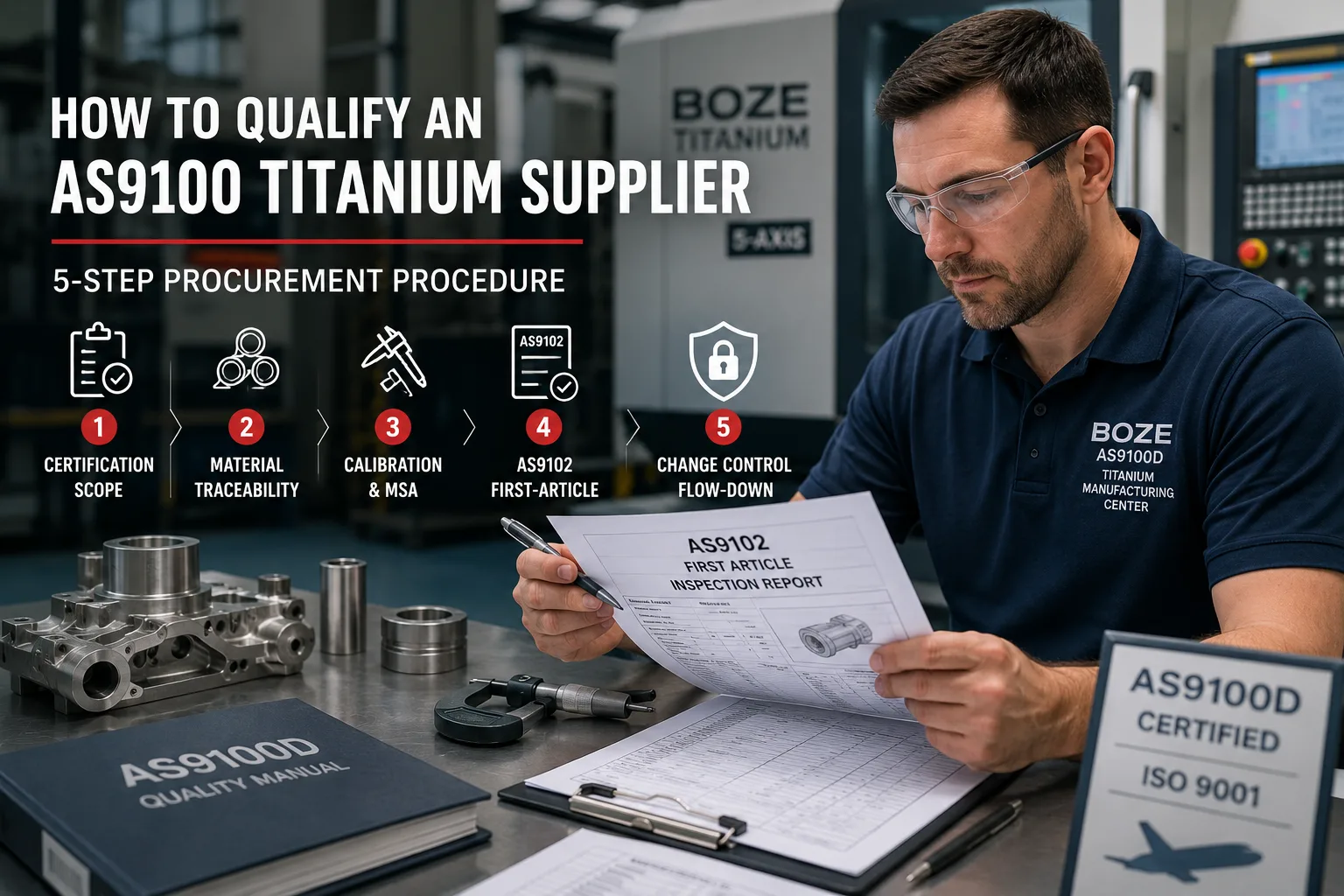
How to Qualify an AS9100 Titanium Supplier — 5-Step Procurement Procedure
A procurement-quality engineer's 5-step procedure for qualifying an AS9100D-certified titanium machining supplier. Covers certification scope, material traceability, calibration / MSA, AS9102 first-article, and change-control flow-down (DFARS / ITAR). References real shop-floor evidence from Boze's AS9100D program.
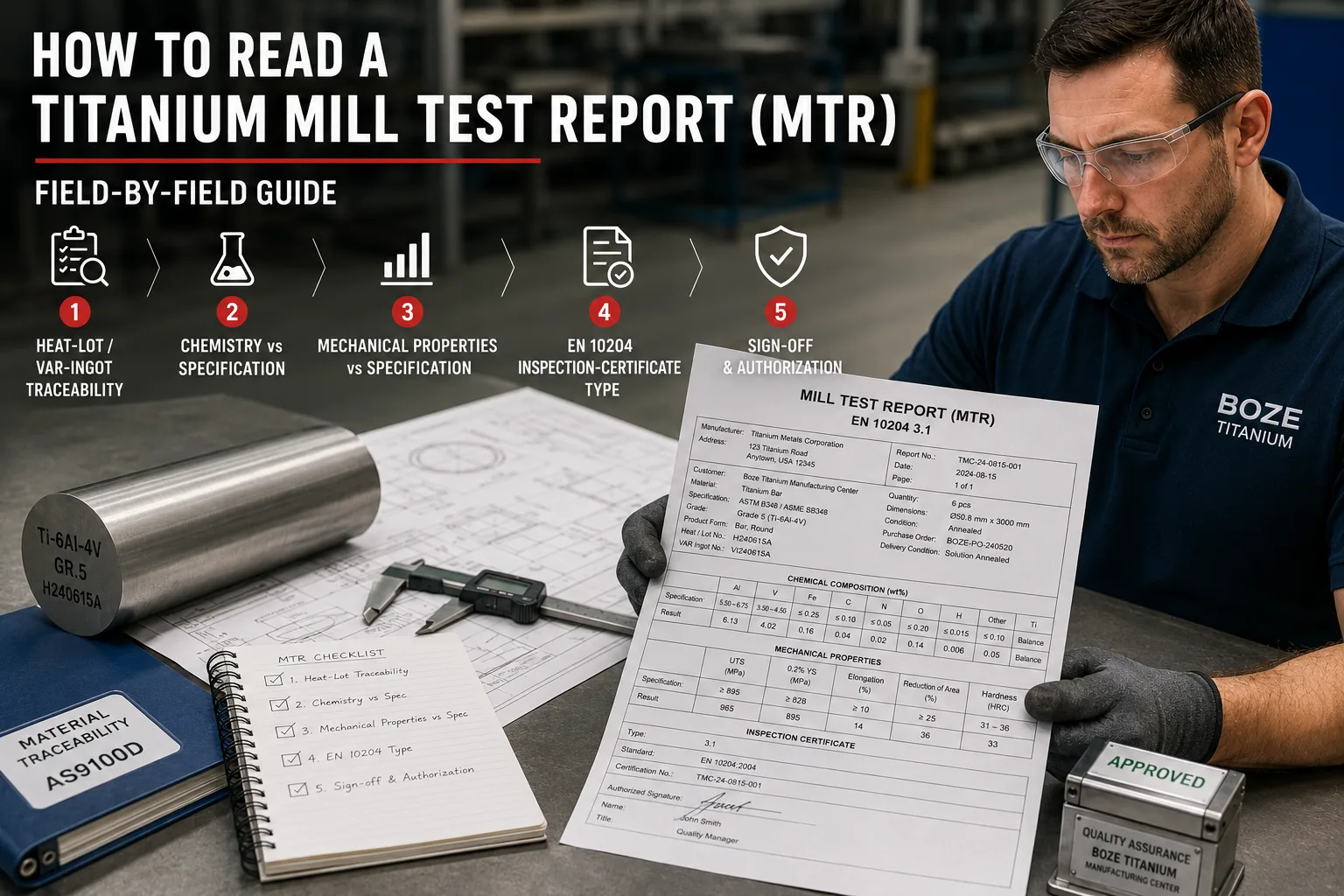
How to Read a Titanium Mill Test Report (MTR) — Field-by-Field Guide
A quality engineer's 5-step procedure for validating a titanium Mill Test Report (MTR): heat-lot / VAR-ingot traceability, chemistry vs specification, mechanical properties vs specification, EN 10204 inspection-certificate type, and sign-off. Includes real MTR field-value examples for Grade 2 / Grade 5 / Grade 23.
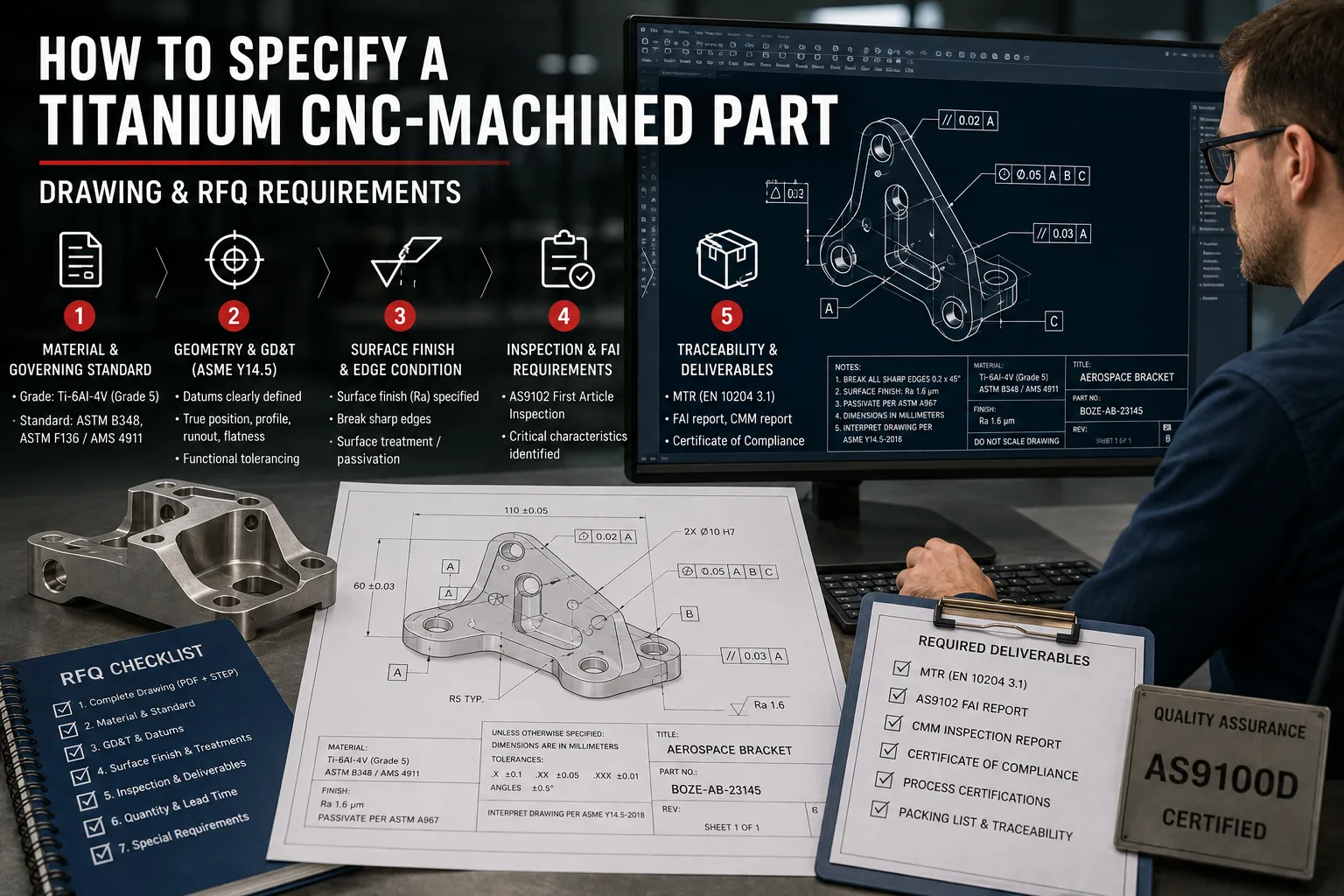
How to Specify a Titanium CNC-Machined Part — Drawing & RFQ Requirements
A mechanical / manufacturing engineer's 5-step procedure for writing a complete, unambiguous specification for a CNC-machined titanium part — grade, governing standard, ASME Y14.5 GD&T, surface finish, FAI / inspection scope, and traceability deliverables. References real drawing call-outs from aerospace, medical, and chemical-process projects.
One Metal. One Focus. Infinite Precision.
Founded in 2011 in Baoji's Titanium Valley, BOZE Metal is dedicated exclusively to titanium — from raw material to precision engineering. AS9100D, ISO 13485 & ISO 9001 certified with 500+ clients across Aerospace, Medical & Motorsport industries, we deliver end-to-end precision titanium CNC machining with full material traceability from source to component.
Boze Titanium Manufacturing Center is operated by Baoji Boze Metal Products Co., Ltd.
Certifications verified by NADCAP and compliant with ASTM International titanium standards (B265, B348, B381, F136, F2924) and ISO 13485 medical-device QMS.